
Coronary Atlas
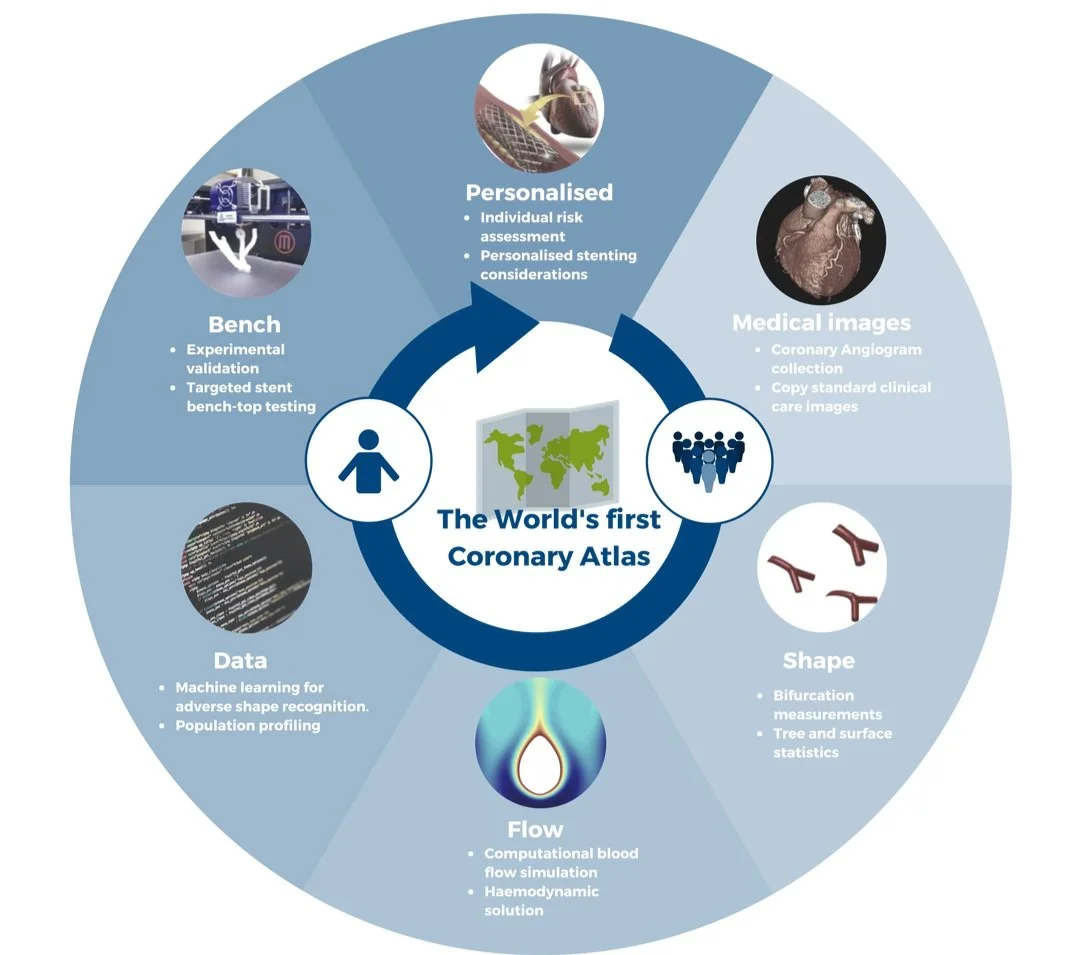
Just like we come in all different sizes and shapes, our arteries do too. Our team drives a personalised medicine approach by accounting for such individual differences.
We are expanding the largest coronary artery population vessel shape and flow database to date. Machine learning and advanced statistics can help us identify patients at higher risk through experimental and computational analysis.
Ultimately, this will help heart disease patients worldwide by providing reliable, early risk assessment, improving patient care, and enabling patient-specific treatment.
Selected publications
Medrano-Gracia P; Ormiston J; Webster M; Beier S; Ellis C; Wang C; Smedby Ö; Young A; Cowan B, 2017, A Study of Coronary Bifurcation Shape in a Normal Population, Journal of Cardiovascular Translational Research, vol. 10, pp. 82 - 90, http://dx.doi.org/10.1007/s12265-016-9720-2
Medrano-Gracia P; Ormiston J; Webster M; Beier S; Young A; Ellis C; Wang C; Smedby Ö; Cowan B, 2016, A computational atlas of normal coronary artery anatomy, EuroIntervention, vol. 12, pp. 845 - 854, http://dx.doi.org/10.4244/EIJV12I7A139
Beier S; Ormiston J; Webster M; Cater J; Norris S; Medrano-Gracia P; Young A; Cowan B, 2016, Impact of bifurcation angle and other anatomical characteristics on blood flow - A computational study of non-stented and stented coronary arteries, Journal of Biomechanics, vol. 49, pp. 1570 - 1582, http://dx.doi.org/10.1016/j.jbiomech.2016.03.038